Wednesday, November 10, 2010

For Thursday: Kim, pp.150-203

The gun Zam-Zammah (featured in Ch.1) today
NOTE: We will spend two more days on Kim, since it is a harder and longer read than the previous books.  Try to finish the book for next Tuesday.  Here are some questions to consider for Thursday's chapters:

* How does Kim continue to grapple with his own identity, particularly regarding the two "paths" that his life seems to take--the chela and the Sahib?  Consider also the famous passage in Chapter 11, "Who is Kim--Kim--Kim?"

* What does Kim learn from the lama?  While he seems eager to learn the ways of the Game from Mahbub and Lurgan Sahib, he is less enthusiastic (initially, perhaps) about the lama's teachings.  Does he seem taken with any of his stories, sayings, or lessons?  Does the lama change Kim in the same way that the Game does?

* Consider the imperialist critique in Chapter 13, when Kim overhears the French and the Russian speaking of India.  What is he commenting on specifically here?  Is it a blanket condemnation of imperialist views, or just aimed at non-English ones?  Consider the Russian's statement, "It is we who can deal with Orientals."

* If we take the lama seriously as a character, how is he "tested" and how does he grow in the same manner as Kim?  What revelations (or disappointments) does he find on his quest?

Thursday, November 4, 2010

For Tuesday: Kipling, Chs. VI-X (pp.79-150)


Delacroix's Women of Algiers (1834)
 Some ideas to consider...

* How does Kipling take to the Great Game and becoming a Sahib?  Does he begin to lose his 'Indian' identity in the face of colonial knowledge?

* Related to this, how does Kim begin to understand his own identity?  Consider the passage in Chapter XII, "No; I am Kim.  This is the great world, and I am only Kim.  Who is Kim?" (96). 

* What is the purpose of the lama's stories and sayings, particularly the 'Jataka' in Chapter IX?  Are these symbolic/allegorical of Kim's journey?  Or are they simply 'Oriental' embellishments of the narrative?

* How does Kim's relationship with the lama progress throughout these chapters?  Why does Kim want to find him again? 

* Discuss the character of Hurree Chunder Mookerjee (or R.17): what role does he seem to play in the work?  How does the narrator (and others) view him and his pursuits? 

* Similarly, who is Lurgan Sahib?  How is he portrayed by the narrator, and how do Kim and others regard him?  Is he another colonial stereotype (like Bennett and others)?  Or is he more like the curator at the museum in the opening chapters?

* How does the narrator continue to comment on the characters and landscape of India, and where do we see a more tolerant (native) view vs. a more condescending ('Orientalist') view?

Friday, October 29, 2010

For Tuesday: Kipling's Kim, Chs. I-V (pp.1-78)

Artwork by Kipling's father based on Kim
Kim is Kipling's best known novel and the only one to gain complete critical admiration (his first novel, The Light That Failed, is largely considered a failure, and his other big one, Captains Courageous, is considered children's lit and rarely discussed).  The novel follows the education of Kim, a half Indian, half Irish orphan who attaches himself to a Buddhist lama who adopts Kim as his "chela" (pupil, but in a religious sense).  Kim eventually ends up in English hands and becomes an agent in "The Great Game," which was the struggle between England and Russia for control of Asia (Russia threatened to invade India for some time, and like England, was mired in endless skirmishes in the mountains of Afghanistan--sound familiar?).  One general thing the novel asks is what path will Kim (as a representative of India, half "English," half "Indian) ultimately take: will he choose the East or the West?  England or India?  Tradition or Empire?  
Other ideas to consider...

* How is the lama portrayed in the early parts of the novel?  He is seen by some critics as wise, representing Kipling's deep love for Indian/Eastern spirituality; to others he's a clown, a buffoon, and mere comic relief.

* Why is Kim drawn to the lama?  What does he see in him? 

* How does Kipling contrast the lama with Mahbub Ali?  Why do they both appreciate Kim--but for different reasons?

* Examine the narrator's tone/perspective in these opening chapters; do we hear an imperialist giving a condescending 'tour' of India, or is it more in the style of Kipling's travel writings such as "Edge of the East?"  Consider this passage from Chapter II: "All India is full of holy man stammering gospels in strange tongues; shaken and consumed in the fires of their own zeal; dreamers, babblers, and visionaries: as it has been from the beginning and will continue to the end" (Longman, 27).  Note that Chapter II opens with a quotation from the poem featured in "Edge of the East."

* How does Kim respond to the Indian landscape/people?  Is he aloof from it like an Englishman, or does it, as Kipling writes in "Home," "[speak] with a strong voice, recalling many things; but the most curious revelation to one man was the sudden knowledge that under these skies lay home and the dearest place in all the world" (Longman, 256)? 

* What do you make of the poems heading each chapter, all of which are drawn from Kipling's own verse?  How do they comment on the themes/actions of the chapter? 

* Why does the lama give up Kim to the English?  Is this part of the 'comedy' of his character, or there something else at work here? 

Tuesday, October 26, 2010

For Thursday: Kipling and Kim (readings in Longman edition)

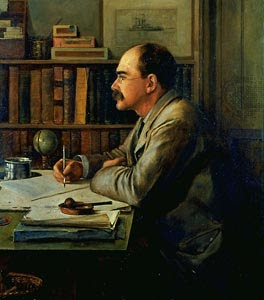
Kipling in his study, writing "Kim"

For Thursday's class, I want you to read some supplementary readings introducing Kipling and the background of Kim (1900).  You will find these readings at the end of the Longman edition beginning on page 255.  Here are the readings I want you to read and respond to for Thursday's class:

* from "Home" (255-258)
* from "The Edge of the East" (258-261)
* from "Something of Myself" (262-263)
"Lispeth" (281-285)
"The Mark of the Beast" (286-296)

In responding to these writings, consider Kipling's role as an English writer who is from India and intimately understands its languages, characters, and customs (unlike Conrad, for example, who came to Africa as an outsider).  Where does an imperialist voice clash with a 'native' voice?  Are his works 'racist'?  How does he depict Englishmen?  Indians?  What tone or point of view does the narrator offer? 

Saturday, October 23, 2010

Exam on Tuesday: The Take-Home Essay

For your essay on Tuesday, you will have 3 short answer questions and one longer essay question.  The topics will be focused on Conrad, Tutuola, and the theoretical ideas that inform their work, such as Ngugi wa Thiong'o, Brantlinger, and Freud.  Below is the take-home essay question which you can get a head start on now if you wish.  It will be due the Tuesday after you take the exam. 

PART III: Take-Home Essay (or, a rough draft for the Final Paper)

For your take-home essay question, I want you to basically lay the groundwork for your final paper.  This will ultimately be a 5-6 page paper using at least two works from class along with secondary/theoretical sources.  But that’s for later.  For now, I want you to respond to the following prompt in a 2-3 page essay that will form the rough draft of your future paper, meaning it will be the basis for what you adapt into a larger, more researched paper. 

THE QUESTION:
In Reader-Response Criticism, critics often refer to an intended reader that is implied by the narrative voice.  This is a reader who is more or less created by the text, and who we must in some sense become to understand the work.  As Ross C. Murfin explains in “What is Reader Response Criticism?” (in our edition of Heart of Darkness),

“Only “by agreeing to play the role of this created audience,” Susan Suleiman explains, “can an actual reader correctly understand and appreciate the work”…Gerard Genette and Gerald Prince prefer to speak of “the naratee,…the necessary counterpart of a given narrator, that is, the person or figure who receives a narrative,”…Iser employs the term “the implied reader,” but he also uses “the educated reader”… (120). 

Using either Conrad or Tutuola, consider what the narrator assumes or asks of the reader: who are “we”?  Are we English?  Male?  What ideas, biases, assumptions, fears, or desires do we have?  What knowledge do we share?  What insights and secrets are we privy to?  What do we know that other characters in this world do not?  What relationship do we share with the narrative voice?  Conversely, who might not be addressed by this narrator…and how intentional is this? 

No sources are required for this, but you must quote from the book in question to support your reading.  Also, be specific; the less specific you are, and the more you generalized, the less points I can give you for your essay.  Good luck! 

Friday, October 15, 2010

For Tuesday: Finish The Palm-Wine Drinkard

I want you to find your own way through the maze of this mythic dreamscape as much as possible; however, following from our discussion on Thursday, consider some of the following ideas:
* Other colonial symbolism in the work (along the lines of the "complete gentleman")

* Elements of traditional oral epic and myth: what parts of the work seem to reach back into a prehistoric past before books and European colonization

* Addresses and asides to his audience: who IS his audience? 

* Recurring imagery, especially babies, eyes, feet, etc. 

* The overall moral or "quest" of the work: how might the work be a modern attempt to explain the world (much as ancient epics used myth to explain the seemingly supernatural)?  How do things come together through the storyteller's art? 

Wednesday, October 13, 2010

REMEMBER...

The Amos Tutuola book most of you purchased has TWO novels in it.  The first one is called "My Life in the Bush Of Ghosts."  DON'T read this one.  Read the SECOND novel, "The Palm Wine Drinkard."  I mentioned this a few times in class, but I want to remind you just in case.  The other novel is great, too, but it's not the one we're reading.