Thursday, December 2, 2010

Exam #3: Postcolonial Play-Acting

Even though this is being assigned early, treat it like a normal final exam: sit down and give yourself 1-2 hours to complete it.  Of course, you can do it early or work on it on and off during the week.  However, the exam is due by on Tuesday.  Just don't look at this as a paper per se; it's not a paper, just a long-answer question on a typical exam. 

Choose ONE of the following scenarios to write a developed response, approximately 3-4 pages double spaced…

1.          You are a high school teacher, and want to teach Kim to your advanced English Literature class.  Unfortunately, the administration, which only knows Kipling from the poem “The White Man’s Burden” (www.fordham.edu/halsall/mod/Kipling.html), claims he is a politically incorrect, racist writer who has no place in a modern classroom.  Defend Kim as a colonial text that is critical of colonialism and plays into many important postcolonial ideas and writing.  Use the book for support and be as persuasive as possible—and don’t give in, even if it does cost you your job! 

2.         You are the director of the Indian Ministry of Tourism, and V.S. Naipaul’s book, An Area of Darkness, has just been released to tremendous acclaim.  A great danger of this book is that it can hurt tourism and make the country synonymous with caste injustice and excrement.  Write a response to specific passages of Naipaul’s book challenging his biases and national identity.  For example, many have accused Naipaul of being too “English” and seeing India as simply not English enough.  As an Indian, what cultural arguments can you make against his work that could not only promote tourism, but challenge his indictment of India’s “medieval mind”? 

REMEMBER, make a persuasive argument for Kipling or against Naipaul, and support this with a close reading of the text.  Don’t generalize or gloss over tricky issues; try to confront them head-on using Kipling or Naipaul’s actual language.  Also consider who you are as you write this: an educator who believes in the power of Kipling’s thought…or a government official who is outraged when an “outsider” tells the world the “truth” about India. 

Good luck! 

Wednesday, December 1, 2010

For Tomorrow: Gracefully (or not) Wrapping Up the Course

Instead of reading more of Naipaul's An Area of Darkness, let's end at Chapter 7 and use tomorrow's class to wrap-up some of the course's ideas.  While I can't hope to provide a last word to the colonial/postcolonial debate, I want to suggest a general sense of what we can take away from the readings and where the issues of a postcolonial society remain to be explored.  I hope to avoid the common misconception that classes are taken "for a grade" and are simply a series of questions and answers; this class, like many of your English classes, is real...the ideas literally shape who writes and how they write, and how other people (in this country, in others) understand what is read.  Any book written in the 21st century can be arguably considered a 'postcolonial' text, as issues of identity, nationality, and power run through every word, character, and chapter.  So we'll do our best to sum up this immense and never-ending debate. 

REMEMBER: your paper is due on Friday IF you want comments by our final exam date; otherwise, it's due ON the Final Exam day, next Tuesday. 

Tuesday, November 23, 2010

For Tuesday: An Area of Darkess, Chs. 6 & 7 (The Medieval City & Pilgrimage)

 
We're rapidly approaching the end of our class and our journey through colonial and postcolonial literature (though we've barely scratched the surface!).  Here are a few ideas to consider with the following chapters....

* How does Naipaul define the "medieval mind"?  Why might this be his greatest critique of Indian and many related postcolonial societies? 

* What view of history (both ancient and recent) is expressed by the people he meets in Chapter 5?  Why does this upset Naipaul?

* Why does Naipaul write that "religious enthusiasm derived, in performance and admiration, from simplicity, from a knowledge of religion only as ritual and form"? 

* Why is Naipaul continually unable to find the "Trinidadian India" in India itself?  What has changed from one world to the next?  What does he expect to find in India, and does he feel one is more "real" than another?  Is Trinidad more pure because it exiled itself from the mainland and stayed true to its values? 

* How does Naipaul feel about the other tourists--particularly American--that he meets on his travels?  How does he distinguish his travels from theirs?  Are they "tourists" in the perjorative sense? 

* Why does Naipaul go on the pilgrimage to see the sacred "lingam"?  What does he hope to see/experience there?  What does he experience?

Friday, November 19, 2010

For Tuesday: An Area of Darkness (Chs.3-5)

Naipaul today, signing a book...
Some ideas to consider...

* How does Naipaul understand/analyze Gandhi's legacy in India?  Why does he write, for instance, "“He looked at India as no Indian was able to; his vision was direct, and this directness was, and is, revolutionary.  He sees exactly what the visitor sees; he does not ignore the obvious" ? 

* According to these chapters, does Naipaul believe the tradition-bound world of India can make a transition to the 20th century?  Can a postcolonial society use its cultural past to forge links to the modern (and perhaps, Western) world? 

* Why is shit important in India?  How does it help Naipaul "read" India? 

* Where does Naipaul find colonial relics and outright British behavior in India?  What does India 'mimic' from Britain and why? 

* In general, how does Naipaul appreciate such fundamental Indian texts such as The Bhagavad Gita, the Kama Sutra, etc.?  Does he respect the cultura/spiritual authority of these texts?  Or do they, too, create an "area of darkness" for those who read/follow them? 

* What is the significant of the servant, Aziz, to Naipaul?  How does it help him understand Indian culture and the power dynamic of colonialism? 

Tuesday, November 16, 2010

For Thursday: V.S. Naipaul, An Area of Darkness (pp.9-67)


NOTE: V.S. Naipaul won the Noble Prize in Literature in 2001, and is one of the most famous (and to some, most hated) of "postcolonial" writers.  He is originally from Trinidad (in the Caribbean), but comes from an Indian/Hindu background.  As a young man he successfully passed exams to obtain a scholarship to study in Oxford, where he recieved a BA degree (studying under Tolkein, among others!).  He quickly became a famous novelist through his works about Trinidadian society, particularly with his most famous book, A House for Mr. Biswas, a semi-autobiographical novel about his father.  After this he turned to writing about the world at large, exposing the postcolonial world's tendency to cling to tradition and imperialist beliefs.  Naipaul became increasingly interested in non-fiction, focusing on works of travel writing (such as An Area of Darkness) which mix travelogue, history, and fiction into a new and exciting genre.  In the last ten years he has returned to novel writing, reworking many old themes into a shorter, more focused critique of the postcolonial world.  His collected papers and manuscripts are deposited at the University of Tulsa (like Rhys!), and he has visited TU to give talks in the past (where I was lucky enough to attend one).  So he has a bona-fide connection to Oklahoma! 

When reading An Area of Darkness, consider some of the following...

* Does Naipaul seem "Indian"?  How does the narrative betray his own issues of identity?  (think of Kim!)

* How does India remind him of his upbringing in Trinidad?  Consider the following passage: "And in India I was to see that so many of the things which the newer and now perhaps truer side of my nature kicked against—the smugness, as it seemed to be, the imperviousness to criticism, the refusal to see, the double-talk and double-think—had an answer in that side of myself which I had thought buried and which India revived as a faint memory (35-36). 

* How does the opening Prelude allow him to examine issues of caste in modern India? 

* Where does he find vestiges of colonialism in his travels? 

* How does the traveler's perspective allow him to see or experience India from a unique perspective?  Why might this technique be more suitable for a postcolonial writer than, say, simply writing a novel about India? 

* Why is the work called "An Area of Darkness"?  Is the same "darkness" we find in Conrad's Africa?  Consider the following quote, "And it was clear that here, and not in Greece, the East began: in this chaos of uneconomical movement, the self-stimulated din, the sudden feeling of insecurity, the conviction that all men were not brothers and that luggage was in danger" (10). 

Monday, November 15, 2010

For Tuesday: Finish Kim if possible!

Tomorrow will be our last day on Kim.  I want to focus specifically on what happens in the end, how other critics view this, and how we read Kim's ultimate "career"--as a chela (Indian) or as an agent (Sahib).  Consider how some of the previous questions are resolved--or not--in these final chapters.  Also note the appearance of the 'Woman of Shamleigh,' who resembles ' 'Lisbeth' from Kipling's earlier story...what is her role in the plot?  What role/voice do women have in this predominantly male adventure narrative? 

I plan to start Naipaul's An Area of Darkness on Thursday, so make sure you have it handy.  A lot of Naipaul will speak to issues in Kipling, and indeed, in a later chapter he even talks about "Kipling's India" and makes references to Kim and other stories.  Indians have a long and very ambivalent relationship to Kim, with some writers more or less admiring his achivement (such as Rushdie, Narayan), while others are critical of the man but find selected truths in his fiction (Naipaul). 

Thursday, November 11, 2010

Paper Assignment: "The Great Game": The Colonial/Postcolonial Audience

In Reader-Response Criticism, critics often refer to an intended reader that is implied by the narrative voice.  This is a reader who is more or less created by the text, and who we must in some sense become to understand the work.  As Ross C. Murfin explains in “What is Reader Response Criticism?” (in our edition of Heart of Darkness):

“Only “by agreeing to play the role of this created audience,” Susan Suleiman explains, “can an actual reader correctly understand and appreciate the work”…Gerard Genette and Gerald Prince prefer to speak of “the naratee,…the necessary counterpart of a given narrator, that is, the person or figure who receives a narrative,”…Iser employs the term “the implied reader,” but he also uses “the educated reader”… (120). 

Using your take-home exam as a basis (I fully expect you to incorporate this reading into the final paper) I want you to choose one colonial work (Oroonoko, Heart of Darkness, Kim) and one postcolonial work (Wide Sargasso Sea, Kim, An Area of Darkness) to analyze on the level of writer & audience.  Who is he/she writing to?  What is the implied audience the author creates, and that we, in a sense, have to become (or reject)?  What things are supposed to be understood to this audience, and what is supposed to stand out as exotic and/or disruptive?  This is especially interesting with postcolonial writers, who are often writing within native traditions and languages, yet are being published in England and read by an English/American audience.  How does this audience shape the work and the author’s material (the plot, characters, denouement, etc.)? 

REQUIREMENTS:
  • You MUST use two books from class.  You can bring in another book as support, but the focus should be readings of one colonial and one postcolonial text.
  • The books can be from different regions; for example, Oroonoko and The Palm-Wine Drinkard.
  • You should have 2-3 critical sources in addition to the primary sources.  Critical sources could include handouts such as Ngugi’s “The Language of African Literature” and Freud’s “The Uncanny,” or books and articles found via the library or JSTOR, etc. 
  • Close reading is very important!  Don’t skim, don’t summarize more than necessary, and don’t generalize.  Cite all sources according to MLA documentation.
  • AT LEAST 4 pages, though more is welcome.  Remember—you have a good 2 pages written already!  Try to develop your take-home essay with sources and perhaps a closer reading (if necessary). 
  • DUE FRIDAY, DECEMBER 3rd (if you want it back with comments by exam day); OR EXAM DAY (if you don’t want it back until next semester). 

Good luck!  Please e-mail me with questions or concerns. 

Wednesday, November 10, 2010

For Thursday: Kim, pp.150-203

The gun Zam-Zammah (featured in Ch.1) today
NOTE: We will spend two more days on Kim, since it is a harder and longer read than the previous books.  Try to finish the book for next Tuesday.  Here are some questions to consider for Thursday's chapters:

* How does Kim continue to grapple with his own identity, particularly regarding the two "paths" that his life seems to take--the chela and the Sahib?  Consider also the famous passage in Chapter 11, "Who is Kim--Kim--Kim?"

* What does Kim learn from the lama?  While he seems eager to learn the ways of the Game from Mahbub and Lurgan Sahib, he is less enthusiastic (initially, perhaps) about the lama's teachings.  Does he seem taken with any of his stories, sayings, or lessons?  Does the lama change Kim in the same way that the Game does?

* Consider the imperialist critique in Chapter 13, when Kim overhears the French and the Russian speaking of India.  What is he commenting on specifically here?  Is it a blanket condemnation of imperialist views, or just aimed at non-English ones?  Consider the Russian's statement, "It is we who can deal with Orientals."

* If we take the lama seriously as a character, how is he "tested" and how does he grow in the same manner as Kim?  What revelations (or disappointments) does he find on his quest?

Thursday, November 4, 2010

For Tuesday: Kipling, Chs. VI-X (pp.79-150)


Delacroix's Women of Algiers (1834)
 Some ideas to consider...

* How does Kipling take to the Great Game and becoming a Sahib?  Does he begin to lose his 'Indian' identity in the face of colonial knowledge?

* Related to this, how does Kim begin to understand his own identity?  Consider the passage in Chapter XII, "No; I am Kim.  This is the great world, and I am only Kim.  Who is Kim?" (96). 

* What is the purpose of the lama's stories and sayings, particularly the 'Jataka' in Chapter IX?  Are these symbolic/allegorical of Kim's journey?  Or are they simply 'Oriental' embellishments of the narrative?

* How does Kim's relationship with the lama progress throughout these chapters?  Why does Kim want to find him again? 

* Discuss the character of Hurree Chunder Mookerjee (or R.17): what role does he seem to play in the work?  How does the narrator (and others) view him and his pursuits? 

* Similarly, who is Lurgan Sahib?  How is he portrayed by the narrator, and how do Kim and others regard him?  Is he another colonial stereotype (like Bennett and others)?  Or is he more like the curator at the museum in the opening chapters?

* How does the narrator continue to comment on the characters and landscape of India, and where do we see a more tolerant (native) view vs. a more condescending ('Orientalist') view?

Friday, October 29, 2010

For Tuesday: Kipling's Kim, Chs. I-V (pp.1-78)

Artwork by Kipling's father based on Kim
Kim is Kipling's best known novel and the only one to gain complete critical admiration (his first novel, The Light That Failed, is largely considered a failure, and his other big one, Captains Courageous, is considered children's lit and rarely discussed).  The novel follows the education of Kim, a half Indian, half Irish orphan who attaches himself to a Buddhist lama who adopts Kim as his "chela" (pupil, but in a religious sense).  Kim eventually ends up in English hands and becomes an agent in "The Great Game," which was the struggle between England and Russia for control of Asia (Russia threatened to invade India for some time, and like England, was mired in endless skirmishes in the mountains of Afghanistan--sound familiar?).  One general thing the novel asks is what path will Kim (as a representative of India, half "English," half "Indian) ultimately take: will he choose the East or the West?  England or India?  Tradition or Empire?  
Other ideas to consider...

* How is the lama portrayed in the early parts of the novel?  He is seen by some critics as wise, representing Kipling's deep love for Indian/Eastern spirituality; to others he's a clown, a buffoon, and mere comic relief.

* Why is Kim drawn to the lama?  What does he see in him? 

* How does Kipling contrast the lama with Mahbub Ali?  Why do they both appreciate Kim--but for different reasons?

* Examine the narrator's tone/perspective in these opening chapters; do we hear an imperialist giving a condescending 'tour' of India, or is it more in the style of Kipling's travel writings such as "Edge of the East?"  Consider this passage from Chapter II: "All India is full of holy man stammering gospels in strange tongues; shaken and consumed in the fires of their own zeal; dreamers, babblers, and visionaries: as it has been from the beginning and will continue to the end" (Longman, 27).  Note that Chapter II opens with a quotation from the poem featured in "Edge of the East."

* How does Kim respond to the Indian landscape/people?  Is he aloof from it like an Englishman, or does it, as Kipling writes in "Home," "[speak] with a strong voice, recalling many things; but the most curious revelation to one man was the sudden knowledge that under these skies lay home and the dearest place in all the world" (Longman, 256)? 

* What do you make of the poems heading each chapter, all of which are drawn from Kipling's own verse?  How do they comment on the themes/actions of the chapter? 

* Why does the lama give up Kim to the English?  Is this part of the 'comedy' of his character, or there something else at work here? 

Tuesday, October 26, 2010

For Thursday: Kipling and Kim (readings in Longman edition)

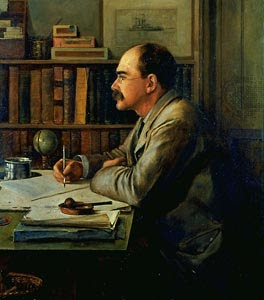
Kipling in his study, writing "Kim"

For Thursday's class, I want you to read some supplementary readings introducing Kipling and the background of Kim (1900).  You will find these readings at the end of the Longman edition beginning on page 255.  Here are the readings I want you to read and respond to for Thursday's class:

* from "Home" (255-258)
* from "The Edge of the East" (258-261)
* from "Something of Myself" (262-263)
"Lispeth" (281-285)
"The Mark of the Beast" (286-296)

In responding to these writings, consider Kipling's role as an English writer who is from India and intimately understands its languages, characters, and customs (unlike Conrad, for example, who came to Africa as an outsider).  Where does an imperialist voice clash with a 'native' voice?  Are his works 'racist'?  How does he depict Englishmen?  Indians?  What tone or point of view does the narrator offer? 

Saturday, October 23, 2010

Exam on Tuesday: The Take-Home Essay

For your essay on Tuesday, you will have 3 short answer questions and one longer essay question.  The topics will be focused on Conrad, Tutuola, and the theoretical ideas that inform their work, such as Ngugi wa Thiong'o, Brantlinger, and Freud.  Below is the take-home essay question which you can get a head start on now if you wish.  It will be due the Tuesday after you take the exam. 

PART III: Take-Home Essay (or, a rough draft for the Final Paper)

For your take-home essay question, I want you to basically lay the groundwork for your final paper.  This will ultimately be a 5-6 page paper using at least two works from class along with secondary/theoretical sources.  But that’s for later.  For now, I want you to respond to the following prompt in a 2-3 page essay that will form the rough draft of your future paper, meaning it will be the basis for what you adapt into a larger, more researched paper. 

THE QUESTION:
In Reader-Response Criticism, critics often refer to an intended reader that is implied by the narrative voice.  This is a reader who is more or less created by the text, and who we must in some sense become to understand the work.  As Ross C. Murfin explains in “What is Reader Response Criticism?” (in our edition of Heart of Darkness),

“Only “by agreeing to play the role of this created audience,” Susan Suleiman explains, “can an actual reader correctly understand and appreciate the work”…Gerard Genette and Gerald Prince prefer to speak of “the naratee,…the necessary counterpart of a given narrator, that is, the person or figure who receives a narrative,”…Iser employs the term “the implied reader,” but he also uses “the educated reader”… (120). 

Using either Conrad or Tutuola, consider what the narrator assumes or asks of the reader: who are “we”?  Are we English?  Male?  What ideas, biases, assumptions, fears, or desires do we have?  What knowledge do we share?  What insights and secrets are we privy to?  What do we know that other characters in this world do not?  What relationship do we share with the narrative voice?  Conversely, who might not be addressed by this narrator…and how intentional is this? 

No sources are required for this, but you must quote from the book in question to support your reading.  Also, be specific; the less specific you are, and the more you generalized, the less points I can give you for your essay.  Good luck! 

Friday, October 15, 2010

For Tuesday: Finish The Palm-Wine Drinkard

I want you to find your own way through the maze of this mythic dreamscape as much as possible; however, following from our discussion on Thursday, consider some of the following ideas:
* Other colonial symbolism in the work (along the lines of the "complete gentleman")

* Elements of traditional oral epic and myth: what parts of the work seem to reach back into a prehistoric past before books and European colonization

* Addresses and asides to his audience: who IS his audience? 

* Recurring imagery, especially babies, eyes, feet, etc. 

* The overall moral or "quest" of the work: how might the work be a modern attempt to explain the world (much as ancient epics used myth to explain the seemingly supernatural)?  How do things come together through the storyteller's art? 

Wednesday, October 13, 2010

REMEMBER...

The Amos Tutuola book most of you purchased has TWO novels in it.  The first one is called "My Life in the Bush Of Ghosts."  DON'T read this one.  Read the SECOND novel, "The Palm Wine Drinkard."  I mentioned this a few times in class, but I want to remind you just in case.  The other novel is great, too, but it's not the one we're reading. 

Tuesday, October 12, 2010

For Thursday: The Palm-Wine Drinkard (read to roughly page 67-ish, when it says "The Work of the Faithful-Mother in the White Tree"

NOTE: This is a potentially difficult text, since it is so outside English/European novelistic traditions.  Indeed, it seems to exist in a world where the English novel never existed, so unaware is the author of the narrative conventions of the genre.  Some approach the work as a transcribed folk-tale, full of unstranslatable ideas and imagery; others consider it a wildly modernist work that dives into the collective pool of myth and the collective unconsciousness.  The ultimate question is how conscious was Tutuola of writing within (or against) the English tradition, or if he was more or less oblivious to this tradition's existence.

Some questions and ideas to consider...

* What passages or sections of the text seem to be calling attention to themselves as translations?  Why might Tutuola want this to read like a translation? 

* In what way is this story like a folk or fairy tale?  Consider the main character, his quest, and his relations/conversations with other characters along the way. 

* What kind of character is the narrator?  Is he reliable—do we believe he truly has superhuman powers and abilities?  Or is this merely a “tall tale” spun out to amuse local villagers and those gullible enough to listen?  


* Where do English/European ideas and words intrude into the text?  How do we understand these seeming anachronisms?  For example, time is often mentioned in English terms, as is distance.  Why not remove this European frame of reference?

* How might this work respond to Ngugi’s arguments about language and nationalism in “The Language of African Literature”?  What do you feel is Tutuola’s view on the purpose of African fiction in preserving indigenous culture? 

* What do we make of the demons and spirits the main character encounters on his journey, such as the “Skull” that borrows human body parts, or the demonstrative and all-powerful baby?  What do these horrors reveal about cultural values, morals, and terrors? 

Wednesday, October 6, 2010

No Class Tomorrow (Thursday)

I've become increasingly ill today, and would rather not stumble through class tomorrow in a haphazard fashion.  So take the day off and plan to discuss Ngugi on Tuesday (the post below gives you some reading suggestions--and the handout is in my box if you need it).  You might also want to start reading Tutola's The Palm Wine Drinkard which we'll officially start next Thursday.  See you next week! 

For Thursday: Handout: Ngugi Wa Thiong'o's "The Language of African Literature"

Read this work in light of Achebe's criticims of Conrad and Kincaid's A Small Place, both of which works are informed by Ngugi's ideas.  The except is part of Chapter 1 of his book, Decolonizing the Mind (1986).  If you missed class, you can find the handout in the box on my door, 336C.  As usual, here are some ideas to ponder or write about:

* What is the true power of language for him?  Why is language so important to a child (or a culture's) mental universe?  What, to him, is the danger of speaking and writing in the colonizer's tongue? 

* Related to this, what does he mean when he writes, "Learning, for a colonial child, became a cerebral activity and not an emotionally felt experience?" (17).

* How does he enter into the debate as to what constitutes "African" literature?  For him is it birth, race, nationality, language, or some other quality? 

* Related to the above, how might he disagree with Achebe's views on literature and art?  How does he criticize Achebe specifically?

* Why, to him, is learning the colonizer's tongue tantamout to betraying one's culture and values? 

* How does storytelling change when you remove one's native tongue?  Why might a story in English not have the same resonance or "lessons" for a child who grew up speaking Gikuyu? 

* What does he mean when he writes, "Language as culture is thus mediating between me and my own self; between my own self and other selves; between me and nature" (15)?

Saturday, October 2, 2010

Daniel Defoe, Pirates & Colonialism


Captain Avery, infamous English pirate
  
NOTE: The reading assignment for this week is in the post below this one. 

Do you ever wonder what we professors do with our spare time?  Do we read books?  Write essays?  Or just make you guys do it?  Well, here's your answer...

I've just published an article related to our class, in that it explores colonialism, English nationalism, and trade/slavery in the 'pirate novels' of Daniel Defoe.  If you're interested in seeing how I use the very arguments/ideas we discuss in class in my own critical writing, this essay may somewhat somewhat interest you, especially if you like pirates!  In general, the article is about how Daniel Defoe used real-life pirates to create a model for the English tradesman, as someone who had the "artistic license" to plunder both domestic and foreign ships in the interest of trade (a trade that would ideally open up foreign markets in "dark" places).  In one work, The King of Pirates (1719), he writes two letters based on the real-life exploits of Captain Avery, a notorious English pirate who raided the treasure ships of the Great Khan and founded a pirate 'utopia' on Madagascar.  In the other work, Captain Singleton (1720), he creates a fictional pirate who rises through the ranks to become one of the most ruthless, yet economically sensible of English pirates with the help of his right-hand mand, William the Quaker (a Quaker pirate!). 

Click here to read the article in Digital Defoe: http://english.illinoisstate.edu/digitaldefoe/

And yes, you can even grade it and offer me comments for revision!

Friday, October 1, 2010

For Tuesday: Brantlinger's essay, "Heart of Darkness: Anti-Imperialism, Racism, or Impressionism?" (277-296)

Patrick Brantlinger: critic of Darkness
Brantlinger's essay sums up some of the modern readings of Heart of Darkness, most notably Chiuna Achebe's charges of HOD as being a racist text that participates in an imperialist discourse.  As you read, consider some of the following ideas and questions:

* What does Brantilinger mean when he calls Conrad an "impressionist" writer?  How does this help us understand the composition/meaning of HOD?

* Can a writer be somewhat racist in real life yet as an artist write free of racial bias, and indeed, critique the very institutions of racism?  How does the essay discuss this?

* In the story Conrad wrote with Ford Madox Hueffer, The Inheritors, he writes that "The old order of things had to live or perish with a lie" (281).  How might this statement inform how we read parts of, if not much of, HOD?

* How does the essay define "commodity fetishism," and how might this relate to the events and characters of HOD?

* Why does Brantlinger argue that "evil is African in Conrad's story" (285)?  How might Conrad's use of imagery and symbolism suggest racist tendencies and, according to Achebe, an underlying imperialist agenda?

* Why does Brantlinger, citing the words of Fredric Jameson, call Conrad a "schizophrenic" writer?  What specifically does this term explain about his writing?

* Brantlinger quotes the philosopher Hannah Arendt, who implicates 19th century imperialism in the rise of Fascism and the Nazi party.  Why might this reading work well with Conrad's depiction of Kurtz?

* On page 291-292, Brantlinger quotes critic Lionel Trilling, who sees Kurtz as something of a heroic, Nietzchean figure.  Does Brantlinger agree with this characterization? 

* Brantlinger suggests that Kurtz is not only a mirror for Marlow but for Conrad (and his story) himself.  Why is this?  How might there be a little of Conrad--and his ideas--in Kurtz? 

Tuesday, September 28, 2010

For Thursday: Part III of Heart of Darkness


More questions/passages/ideas to chew on...


* Toward the end of the work, Marlow is discussing Kurtz with the manager, who dismisses Kurtz’s madness as the result of an “unsound method.”  Marlow counters with “No method at all.”  In other passages of the work, Marlow discusses his method—or the need for one.  What does he mean by this?  What quality does he feel he has that Kurtz lacks? 

* A passage to consider, page 74: "But the wilderness had found him out early, and had taken on him a terrible vengeance for the fantastic invasion.  I think it had whispered to him things about himself which he did not know, things of which he had no conception till he took counsel with this great solitude—and the whisper had proved irresistibly fascinating.  It echoed loudly within him because he was hollow at the core…”

* And on page 75: "I seemed at one bound to have been transported into some lightless region of subtle horrors, where pure, uncomplicated savagery was a positive relief, being something that had a right to exist—obviously—in the sunshine."

Re-read the famous passage, where Kurtz, ill and nearly insensible, cries out “the horror!  the horror!”  What does Marlowe believe he has “seen” to provoke this outcry, and has he seen it himself?


Related to the above, why does Marlow lie about Kurtz’s last words to his fiancĂ©e?  This passage seems to relate to an earlier statement Marlow made about women…what is he protecting here?